How It Works Solutions Tools Resources Glossary Get Early Access
See how the math works behind Guidance. Get Early Access →
The Engine

The Mathematical Operating System for CPG Brands

Guidance is not a spreadsheet replacement or a basic ERP. It is a deterministic mathematical engine that automatically calculates true COGS, propagates cost changes in real time, and tells you exactly what your margin is on every SKU in every channel — with a confidence score attached to every number.

Get Early Access
The Problem

Why CPG Math Is Broken Without the Right Engine

A CPG brand selling through UNFI, Amazon, and its own DTC store is not running one business — it is running three different margin structures simultaneously. Each channel has its own deductions, fees, freight costs, and promotional allowances. Each production run has its own yield variance. Each ingredient has its own price history and tariff exposure.

Most brands track this in Excel. Some use QuickBooks. A few use ERPs built for discrete manufacturing, not food. The result is the same in every case: COGS is always slightly wrong, margins are always slightly off, and nobody knows by exactly how much.

Guidance was built to solve this problem with math — not with better spreadsheets, but with a purpose-built computational engine that handles the full complexity of CPG operations automatically.


The Architecture

Six Layers. One Source of Truth.

The Guidance engine is organized into six sequential layers. Each layer takes the output of the previous one as its input. The result is a single, continuously updated number for every metric that matters — from raw ingredient cost to net margin per unit sold on Amazon after all fees, deductions, and trade spend.
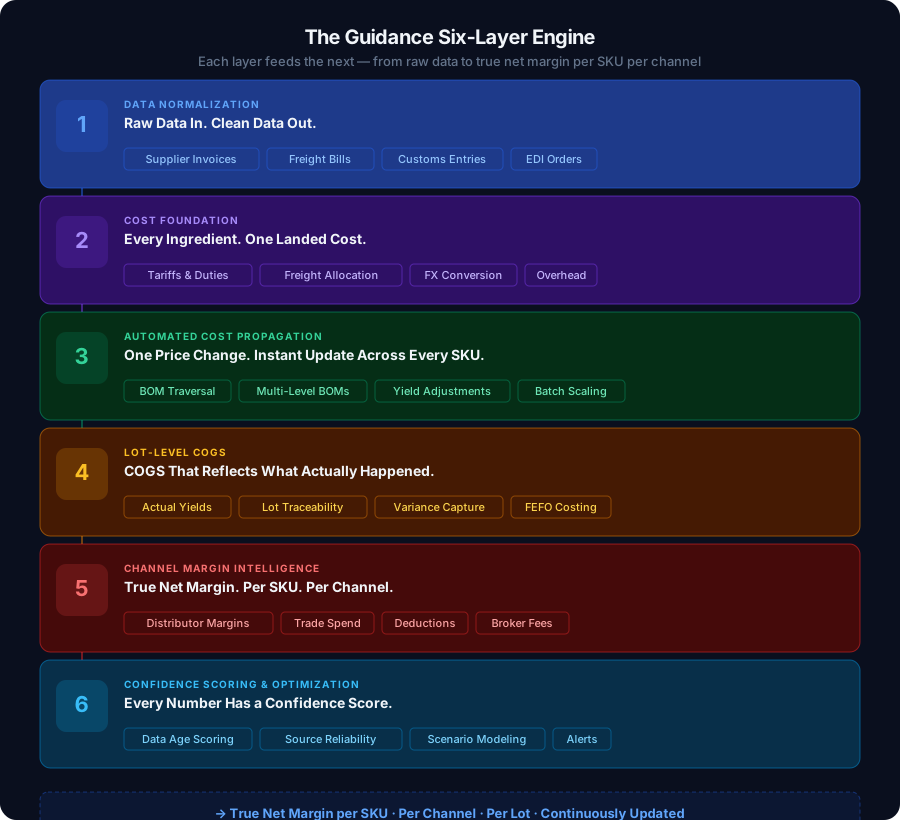
The Guidance Six-Layer Engine — architecture diagram showing all 6 layers from data normalization to confidence scoring
1
Data Normalization

Raw Data In. Clean Data Out.

Before any math can happen, the data has to be clean. Guidance ingests supplier invoices, distributor remittance files, production records, and sales data — and normalizes all of it into a unified internal format.

This includes resolving the hardest normalization problem in CPG: distributor deduction codes. UNFI, KeHE, and every other distributor uses a different taxonomy for deductions (spoils, MCB, OI, EDLC, scan-backs). Guidance maps all of them to a universal deduction taxonomy so that every deduction is categorized, tracked, and attributed to the correct SKU and promotion.

Supplier invoice parsing Distributor deduction normalization Unit of measure conversion Lot number reconciliation
2
Cost Foundation

Every Ingredient. Every Overhead. One Landed Cost.

The cost foundation layer calculates the true landed cost of every ingredient and packaging component — not just the invoice price, but the full cost including freight, duty, tariffs, and any applicable Section 301 surcharges.

Costs are tracked at the lot level, which means when the same ingredient arrives at different prices across different purchase orders, Guidance knows which lot was used in which production run and applies the correct cost to each batch — not an average.

Landed cost calculation Tariff & duty allocation Lot-level cost tracking Overhead absorption Section 263A UNICAP
3
Automated Cost Propagation

One Price Change. Instant Update Across Every SKU.

This is Guidance's core differentiator. When a supplier raises the price of an ingredient, the change propagates automatically through every BOM that uses that ingredient, recalculating the COGS for every affected SKU in real time.

No manual updates. No "I'll fix the spreadsheet later." No discovering three months after the fact that your margins were wrong because you forgot to update the BOM for the reformulated version of your top SKU.

The propagation engine also handles multi-level BOMs — if a sub-assembly uses an ingredient that changed price, the cost change flows through the sub-assembly and up to the finished good automatically.

Real-time cost propagation Multi-level BOM support Yield variance adjustment Reformulation tracking
4
Lot-Level COGS

COGS That Reflects What Actually Happened in Production.

Standard COGS calculations use standard costs — what you expected to spend. Guidance calculates actual COGS at the lot level — what you actually spent, accounting for yield variance, rework, waste, and any production deviations.

If your production yield was 94% instead of the expected 97%, Guidance knows. The COGS for that lot reflects the actual yield, not the theoretical one. Over time, the system learns your typical yield ranges and flags deviations that suggest a process problem or a supplier quality issue.

Actual vs. standard cost variance Yield variance tracking Lot-level COGS attribution Production deviation flagging
5
Channel Margin Intelligence

True Net Margin. Per SKU. Per Channel. After Everything.

COGS is only half the picture. What a brand actually keeps depends on which channel the product was sold through. A unit sold through UNFI has a completely different net margin than the same unit sold DTC or on Amazon — because each channel has its own deductions, fees, freight costs, and promotional allowances.

Guidance calculates true net margin for every SKU in every channel simultaneously. UNFI deductions (spoils, MCB, OI) are categorized and deducted. Amazon referral fees, FBA fees, and advertising costs are applied. DTC payment processing, shipping, and return rates are factored in. The result is a single, accurate net margin number for each channel — not an estimate.

UNFI / KeHE deduction categorization Amazon FBA & referral fee calculation DTC margin calculation Trade spend attribution Broker commission tracking
6
Confidence Scoring & Optimization

Every Number Comes With a Grade.

Every calculation in Guidance carries a Confidence Score — a grade from 0 to 100 that tells you how much to trust the number. A COGS figure based on a confirmed supplier invoice, an actual production record, and a reconciled distributor remittance gets a high confidence score. A COGS figure based on a 90-day-old price estimate gets a low one.

This matters because in CPG, you are always making decisions with incomplete data. The Confidence Score tells you which numbers are solid and which ones need to be updated before you make a pricing or channel allocation decision.

The optimization layer uses the confidence-scored data to surface actionable insights: which SKUs have deteriorating margins, which channels are underperforming relative to their cost structure, and where a price increase or channel reallocation would have the highest impact.

Data freshness scoring Confidence-weighted reporting Margin deterioration alerts Channel optimization recommendations Scenario simulation

Why It Matters

What This Means in Practice

The six-layer architecture is not an academic exercise. It exists because CPG operations have specific mathematical problems that general-purpose software does not solve. Here is what that looks like in practice.

Ingredient price change? COGS updates in seconds.

When a supplier raises the price of your oat flour by $0.08/lb, Guidance recalculates the COGS for every SKU that uses oat flour — across every BOM, every channel, every open purchase order — automatically.

📦

Lot-level traceability built into the cost engine.

Because costs are tracked at the lot level, a full recall trace is a byproduct of normal operations — not a separate emergency process. You always know which lots used which ingredients, at what cost, in which production runs.

📊

Channel margin calculated after every deduction.

Most brands estimate their UNFI margin. Guidance calculates it — after every spoils deduction, every MCB, every OI, every scan-back — reconciled against the actual remittance file.

🎯

Confidence scores tell you which numbers to trust.

You always know which parts of your P&L are based on confirmed data and which are based on estimates. No more presenting margin numbers to your board and quietly hoping the COGS figure is right.

🔮

Scenario simulation before you commit.

Model a 15% tariff increase, a reformulation, a new channel launch, or a price change — and see the exact impact on net margin across every SKU and every channel before you make the decision.

🏭

Built for co-packer relationships.

Guidance handles the complexity of co-manufacturing: variable yields, toll processing fees, co-packer-owned ingredients, and split production runs across multiple facilities — all tracked and costed correctly.


How We Compare

Guidance vs. the Alternatives

Most CPG brands use one of three approaches before Guidance: spreadsheets, QuickBooks, or a general-purpose ERP. Here is how the math capability compares.

Capability Spreadsheets QuickBooks Generic ERP Guidance
Automated cost propagation ✗ Manual ✗ Manual ✗ Manual ✓ Automatic
Lot-level COGS (actual vs. standard) Partial ✓ Full
Distributor deduction categorization ✓ UNFI, KeHE + any distributor
True net margin by channel ✗ Estimate only ✓ After all deductions & fees
Confidence scoring on calculations ✓ Every number graded
Scenario simulation Manual copy Limited ✓ Real-time
Tariff & duty impact on COGS ✓ Automatic
Co-packer yield variance tracking Partial ✓ Full

Go Deeper

Learn More About the Math

Each layer of the Guidance engine has its own dedicated article explaining the underlying concepts, the formulas operators need to understand, and how Guidance handles it automatically.

Layer 3
What Is Automated Cost Propagation and Why CPG Brands Need It
Layer 5
True Net Margin by Channel: The Math Every CPG Brand Needs
Layer 6
Confidence Scoring: Why Your COGS Might Be Wrong Right Now
Layer 1
UNFI Deduction Codes Explained: Every Code, What It Means, How to Dispute
Layer 6
How to Simulate a Tariff Increase Before It Hits Your Margins
Foundation
How to Calculate COGS for a Food Brand: Formula, Examples & Common Mistakes

Ready to See the Engine in Action?

Join the waitlist for early access. We are onboarding a small group of CPG brands to work directly with the team and shape the product.

Get Early Access to Guidance